Geograph British Isles is a crowdsourcing project that "...aims to collect geographically representative photographs and information for every square kilometre of Great Britain and Ireland." They just got their 1,000,000th photograph today. It's called, "Minor road near Aberuchill." Here it is:

Geograph British Isles
Showing posts with label photography. Show all posts
Showing posts with label photography. Show all posts
Wednesday, October 15, 2008
Geograph British Isles


Thursday, October 9, 2008
The Fulgurator

The Image Fulgurator is a device for physically manipulating photographs. It intervenes when a photo is being taken, without the photographer being able to detect anything. The manipulation is only visible on the photo afterwards.
In principle, the Fulgurator can be used anywhere where there is another camera nearby that is being used with a flash. It operates via a kind of reactive flash projection that enables an image to be projected on an object exactly at the moment when someone else is photographing it. The intervention is unobtrusive because it takes only a few milliseconds. Every photo another photographer takes of an object at which the Fulgurator is also aimed is affected by the manipulation. Hence visual information can be smuggled unnoticed into the images of others. (juliusvonbismarck.com)
Tuesday, September 30, 2008
Taryn Simon: An American Index of the Hidden and Unfamiliar

Taryn Simon is of a younger generation (she is 31), and what she is after, in a remarkable new body of work she calls “An American Index of the Hidden and Unfamiliar,” is something altogether different: a sense of what we won’t allow one another to see. In the realms of government, science, security and nature, among others, Simon has gained access where few others have. Yet the resulting photographs carry no sense of struggle or shadowy danger. Like her pictures of tsunami victims and of men who were wrongfully convicted of violent crimes, which have appeared previously in our pages, these “Index” works are formal, carefully lighted, quiet, still: they’re portraits, not snapshots. (This March, these images will be collected in a book published by Steidl and also exhibited at the Whitney Museum of American Art.) What’s most strongly conveyed, perhaps, by a close study of these photographs, is how intricate and often systematic this off-limits land of ours is — how conscientious we can be about what we don’t want to be conscious of. (nytimes.com)View photos from the exhibition at tarynsimon.com
Saturday, September 27, 2008
Rephotographing Atget
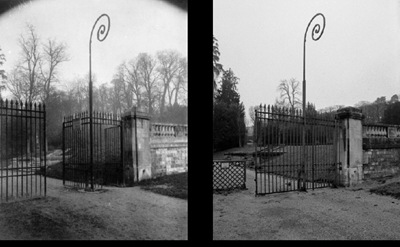
Christopher Rauschenberg writes:
Eugene Atget documented Paris from 1888 until his death in 1927. Like many people, I consider him to have been the greatest photographer of all time. Atget straightforwardly documented the city with photographs that give you the feeling that all the transitory things that people do and are have washed away, leaving only their transcendent accomplishments.
On a 1989 trip to Paris, I suddenly found myself face to face with a spiral-topped gatepost that I knew very well from a beautiful photograph by Atget (the photograph on the left). I rephotographed his gatepost from memory (the photograph on the right) and wondered how many other Atget subjects might still be holding their poses.
There, among the things and places that Atget had admired, I resolved to return and do a rephotographic exploration to discover if the haunting and beautiful Paris of Atget’s vision still existed. (lensculture.com)
A selected archive of Atget's photographs is hosted at George Eastman House.
Friday, May 30, 2008
Edward Burtynsky: TED Prize wish: Share the story of Earth's manufactured landscapes
Accepting his 2005 TED Prize, photographer Edward Burtynsky makes a wish: that his images -- stunning landscapes that document humanity's impact on the world -- help persuade millions to join a global conversation on sustainability. (ted.com)
Wednesday, April 30, 2008
Exposure
 An outstanding New Yorker article about "the woman behind the camera at Abu Ghraib," by Philip Gourevitch and Errol Morris:
She liked to look. She might recoil from violence, but she was drawn to its aftermath. When others wanted to look away, she’d want to look more closely. Wounded and dead bodies fascinated her. “She would not let you step on an ant,” Sergeant Davis said. “But if it dies she’d want to know how it died.” And taking pictures fascinated her. “Even if somebody is hurt, the first thing I think about is taking photos of that injury,” Harman said. “Of course, I’m going to help them first, but the first reaction is to take a photo.” In July, she wrote to her father, “On June 23 I saw my first dead body I took pictures! The other day I heard my first grenade go off. Fun!” Later, she paid a visit to an Al Hillah morgue and took pictures: mummified bodies, smoked by decay; extreme closeups of their faces, their lifeless hands, the torn flesh and bone of their wounds; a punctured chest, a severed foot. The photographs are ripe with forensic information. Harman also had her picture taken at the morgue, leaning over one of the blackened corpses, her sun-flushed cheek inches from its crusted eye sockets. She is smiling—a forced but lovely smile—and her right hand is raised in a fist, giving the thumbs-up, as she usually did when a camera was pointed at her. (The New Yorker)A very friendly and snappy tip of the hat to the inimitable didactique...via Facebook.
Subscribe to:
Posts (Atom)

 Posts
Posts

