via Architectradure.
Showing posts with label urban space. Show all posts
Showing posts with label urban space. Show all posts
Saturday, October 4, 2008


Saturday, September 27, 2008
Rephotographing Atget
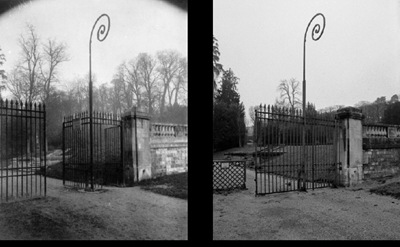
Christopher Rauschenberg writes:
Eugene Atget documented Paris from 1888 until his death in 1927. Like many people, I consider him to have been the greatest photographer of all time. Atget straightforwardly documented the city with photographs that give you the feeling that all the transitory things that people do and are have washed away, leaving only their transcendent accomplishments.
On a 1989 trip to Paris, I suddenly found myself face to face with a spiral-topped gatepost that I knew very well from a beautiful photograph by Atget (the photograph on the left). I rephotographed his gatepost from memory (the photograph on the right) and wondered how many other Atget subjects might still be holding their poses.
There, among the things and places that Atget had admired, I resolved to return and do a rephotographic exploration to discover if the haunting and beautiful Paris of Atget’s vision still existed. (lensculture.com)
A selected archive of Atget's photographs is hosted at George Eastman House.
Tuesday, September 23, 2008
The Most Ridiculous City in the World
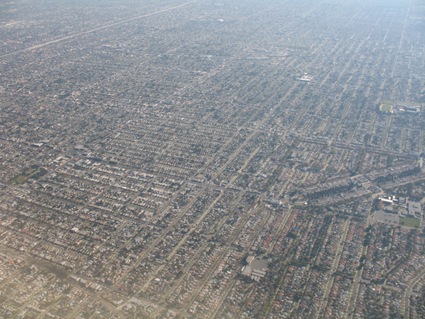
Geoff at bldgblog articulates what makes living in Los Angeles so confounding, liberating and existentially raw:
Los Angeles is where you confront the objective fact that you mean nothing; the desert, the ocean, the tectonic plates, the clear skies, the sun itself, the Hollywood Walk of Fame – even the parking lots: everything there somehow precedes you, even new construction sites, and it's bigger than you and more abstract than you and indifferent to you. You don't matter. You're free. (bldgblog)
Hat tip: E.G.
More/tangent: Mike Davis, Ecology of Fear
Monday, September 22, 2008
Seven City Symphonies (1921-1931)
One of the projects I'm working on involves crowdsourcing video clips to construct a database for a "recombinant city symphony." I thought it would be useful to go back and look at some of the classics of the genre as touchstones for tone and structure. Viz:
Paul Strand, Manhatta (1921)
René Clair, Paris qui dort (1925)
Walter Ruttman, Berlin: Symphony of a Great City (1927)
Joris Ivens, Regen (1929)
Dziga Vertov, Man With A Movie Camera (1929)
Jean Vigo, Apropos de Nice (1930)
Jay Leyda, A Bronx Morning (1931)
Edit: Added Manhatta by Paul Strand.
Friday, August 8, 2008

Wednesday, May 28, 2008
Friday, May 16, 2008
Liberty City Pics and GTA IV Review Roundup

Check out this great photoset by Flickr user and virtual flâneur Matthew Johnston comparing locations in New York City to their virtual counterparts in Grand Theft Auto IV's Liberty City (hat tip: teleclinica).
I've been playing GTA IV over the past week and am extremely impressed by the depth of the game, both as a satirical city/culture sim and as a compelling multithreaded narrative. And despite the usual outrage that accompanies a GTA release, the reviews in the mainstream press (and everywhere else -- the game rates an incredible 98/100 on metacritic.com) suggest that this iteration of the series is something of a watershed moment for gaming. The Onion A/V club, for example, went so far as to compare the game to the much-lauded TV series, The Wire. Here are a few more perspectives, sampled from major press outlets:
NYT: Grand Theft Auto Takes On New York
Grand Theft Auto IV is a violent, intelligent, profane, endearing, obnoxious, sly, richly textured and thoroughly compelling work of cultural satire disguised as fun. It calls to mind a rollicking R-rated version of Mad magazine featuring Dave Chappelle and Quentin Tarantino, and sets a new standard for what is possible in interactive arts. It is by far the best game of the series, which made its debut in 1997 and has since sold more than 70 million copies. (New York Times)

Slate: It's Not Just About Killing Hookers Anymore
Each player will encounter a million different facets of this virtual world at his own pace and in his own unique order. It's the sort of experience that you can't get from any other medium, and no game has ever done it better than GTA IV. The reputation of the series might be too far gone for nongamers and politicians to appreciate the depth and richness of this amazing game. But Grand Theft Auto IV is not an orgy of death. It's a living, breathing place—and when you're forced to kill, it's nothing to celebrate. (Slate)

The Guardian: How Grand Theft Auto smashed the system
At the heart of it all, there is a modern interpretation of the American Dream as immigrant experience. Lead character Niko Bellic is a Serbian national with a violent military past who arrives in Liberty City via a rusted container ship. He is the archetypal outsider, striving to start a new life in the Land of the Free; a Vito Corleone for the 21st century. There are also themes of ethnicity, race and identity in contemporary America, of heritage and culture, of the struggle to fit in. When Niko arrives, he's quickly forced to assimilate into an Eastern European criminal underworld. For him, there is no escape from the old life, the old country.
Of course, all this stuff lurks in the background and doesn't have to interfere with the anarchic action. Plenty of people might play the game without ever realising its true complexity - but it might give you something to think about the next time you launch an RPG down a crowded Liberty City street. (The Guardian)
Thursday, April 17, 2008
Vertical Farms for NYC

New York magazine asked four architects to dream up proposals for a lot on Canal Street and Work AC came up with this. “We thought we’d bring the farm back to the city and stretch it vertically,” says Work AC co-principal Dan Wood. “We are interested in urban farming and the notion of trying to make our cities more sustainable by cutting the miles [food travels],” adds his co-principal (and wife) Amale Andraos. Underneath is what appears to be a farmers market, selling what grows above. Artists would be commissioned to design the columns that hold it up and define the space under: “We show a Brancusi, but it could be anyone,” says Wood. (treehugger)
Thursday, February 21, 2008
Ground-Up City

Ground-up City. Play as a Design Tool maps the continuing history of an urban design strategy for play in the city. Liane Lefaivre has developed a theoretical model for tackling playgrounds as an urban strategy. She steps off from a historical overview of play and the ludic in art, architecture and urban design, focusing particularly on the post-war playgrounds realized in Amsterdam as joint ventures between Aldo van Eyck, Cornelis van Eesteren and Jakoba Mulder. The architecture firm Döll - Atelier voor Bouwkunst explored the possibility of applying the model in two urban redevelopment areas in Rotterdam, Oude Westen in the inner city and Meeuwenplaat in Hoogvliet, an outlying postwar district, refining it into a practical design strategy. A second layer in the book gives an inspirational and refreshing new look at play in a picture essay with a welter of reference images illustrating play as an urban phenomenon. Ground-up City places the playground high on the agenda as an urban design challenge. It also shows how specifying a generic, academic model for a particular situation can lead to a practically applicable design resource. (010publishers.nl)More info, review and links: WMMNA
Friday, September 28, 2007
Los Angeles 2106
As the second phase of The City of the Future challenge, IBM and The History Channel, in partnership with the American Society of Civil Engineers (ASCE), challenged engineering students in NYC, Chicago and LA to propose innovative engineering solutions that will sustain our great cities in the 22nd century. The students had 5 weeks to develop their solutions before presenting their proposals to the panels of esteemed jurors at IBM offices in each city. Each team exhibited extraordinary vision and innovation but only one team in each city was named winner. The jurors voted and the IBM Engineers of the Future are… (history.com)
Sunday, September 9, 2007
Projection Bombing

Outdoor digital projection in urban environments is a great method for getting your content up big before the eyes and in the minds of your fellow city inhabitants. This tutorial comes out of trial and error and it works. (Instructables: Projection Bombing)
Subscribe to:
Posts (Atom)

 Posts
Posts

